A House Divided: Bipartisan Anti-War Resolution Fails in Both Chambers Allowing The War in Iran to Continue

In a significant test of executive war-making authority, the House of Representatives narrowly failed to pass a bipartisan War Powers Resolution on Thursday, March 5, 2026. The measure, which sought to force an end to unauthorized military hostilities against Iran, was defeated in a 212–219 vote. The result ensures that the Trump administration can proceed with "Operation Epic Fury"—a rapidly intensifying conflict that began with a massive wave of strikes on February 28—without immediate legislative restraint.
A Bipartisan Push for Restraint
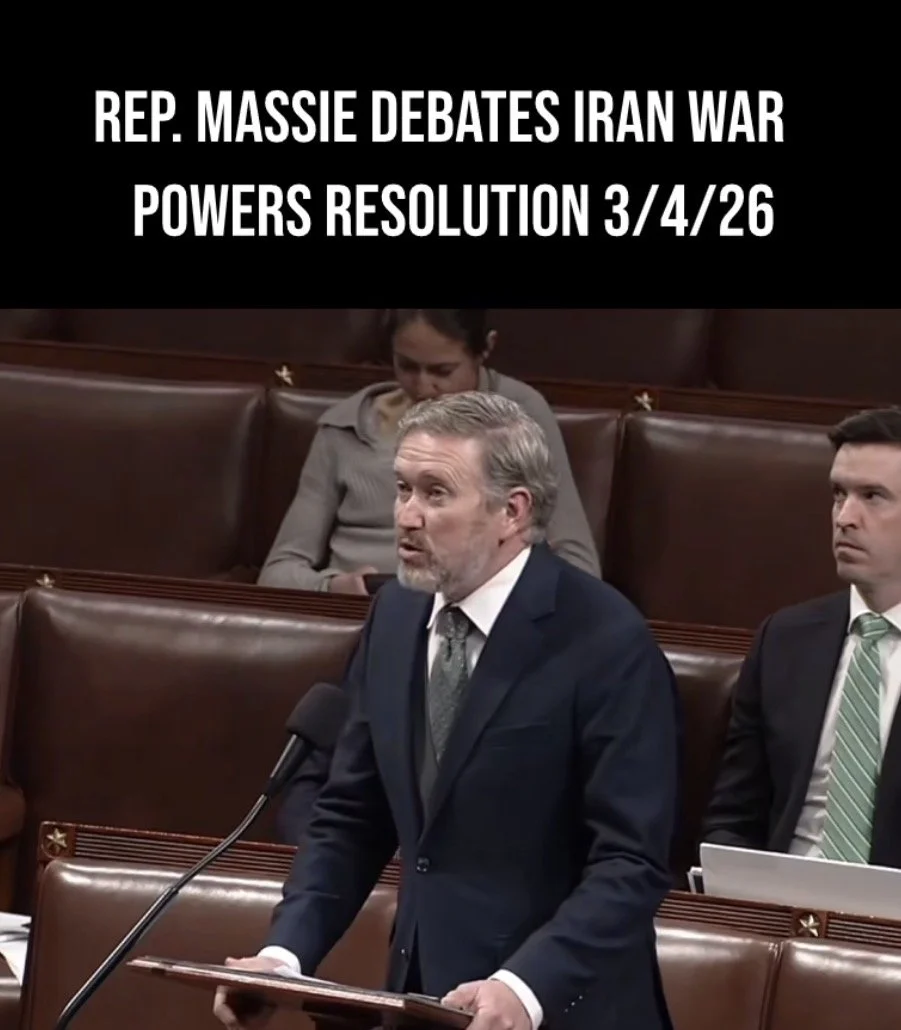
The resolution was a rare display of cross-party collaboration in a deeply polarized Congress. Introduced by Representative Ro Khanna (D-CA) and Representative Thomas Massie (R-KY), the measure invoked the 1973 War Powers Resolution to demand the removal of U.S. forces from hostilities "within or against the Islamic Republic of Iran" unless Congress specifically authorized the action.
The debate centered on Article I of the Constitution, which vests the power to declare war in the legislature. Massie, a consistent critic of executive overreach, argued on the House floor that the administration had met none of the legal requirements for unilateral action, stating, "Iran has not attacked the United States, and Congress has not granted specific statutory authorization." While nearly all Democrats supported the measure, four defected to join the Republican majority. Conversely, two Republicans—Massie and Representative Warren Davidson (OH)—voted with Democrats to rein in the White House.
The Senate Stalemate
The House vote followed a similar defeat in the Senate on Wednesday, where a measure led by Senator Tim Kaine (D-VA) and co-sponsored by Senator Rand Paul (R-KY) failed to clear a procedural hurdle in a 47–53 vote. Like the House version, the Senate resolution fell largely along party lines. Senator John Fetterman (D-PA) broke ranks to oppose the measure, while Rand Paul stood as the lone Republican supporter.
Despite the failure, Senator Kaine signaled that he would continue to force votes as the conflict evolves, noting that "shifting rationales" from the administration are deepening skepticism among lawmakers who fear a "forever war" without a defined endgame.
Concerns Over Presidential Overreach
The primary driver of the legislative push is a growing alarm over the Trump administration’s decision to bypass Congress entirely. Critics point out that the administration has provided inconsistent justifications for the conflict, at times citing an "imminent threat" and at others describing the operation as a campaign for "regime change" following the death of Iran's Supreme Leader.
Furthermore, Defense Secretary Pete Hegseth recently suggested that hostilities could continue for at least eight weeks, a timeline that critics say far exceeds the President’s constitutional authority for emergency military action. With the conflict reportedly costing over $1 billion a day and the administration refusing to rule out the insertion of ground troops, lawmakers on both sides of the aisle are warning of a dangerous "mission creep" that could destabilize the entire Middle East.
