U.S. and Iran Trade Heavy Strikes as Ceasefire Fails
The fragile peace in West Asia has shattered completely. A series of escalating military actions between the United States and Iran has pushed the region back into the throes of an all-out war. Less than two months after a shaky, April-brokered truce offered a brief reprieve to regional populations, direct hostilities have erupted with renewed fury following the downing of an American military helicopter.
With global energy markets reeling, Israel expanding its own localized operations, and the United States Congress fiercely attempting to rein in presidential war powers, the geopolitical landscape has grown exceptionally volatile.
The Catalyst: Monday Night’s Helicopter Downing and the U.S. Response
The latest cycle of violence began on Monday evening, June 8, 2026, when a U.S. Army Apache attack helicopter gunship went down in the waters near the Strait of Hormuz and the coast of Oman. Washington immediately pointed the finger at Tehran, confirming that the crewed aircraft had been targeted and shot down by Iranian forces.
In a remarkably swift operation, the two Army aviators were rescued from the Persian Gulf waters roughly two hours after going down. Strikingly, the recovery was executed by a 24-foot "Corsair" autonomous surface sea drone—marking the first operational rescue of its kind by an unmanned vehicle in military history.
Following their recovery, President Donald Trump addressed the public, stating that the pilots were in stable condition and had suffered no major injuries. Despite the positive health status of the aircrew, the administration emphasized that a severe breach had occurred. "We must, of necessity, respond to this attack," President Trump declared, promising a swift and forceful retaliation.
By early Wednesday morning, June 10, the U.S. military completed what it termed "self-defense strikes." U.S. Central Command (CENTCOM) utilized Air Force and Navy fighter jets to launch a wave of proportional attacks on Iranian infrastructure around the Strait of Hormuz, hitting Iranian air defense installations, ground-control stations, surveillance radar sites and two critical water reservoirs in the southern port town of Sirik, cutting off drinking water for roughly 20,000 residents amid blistering summer heat.
Iran Strikes Back: Regional U.S. Bases Under Fire
Tehran wasted little time executing its promise to "leave no attack or threat unanswered." Within hours of the American strikes, Iran’s Islamic Revolutionary Guard Corps (IRGC) launched a barrage of long-range missiles and drone clusters across the Middle East. The targets were clear: regional military hubs hosting American personnel and assets.
Iranian state media reported hitting the U.S. Fifth Fleet headquarters in Bahrain, alongside the Ali al-Salem airbase in Kuwait. Simultaneously, a wave of missiles targeted the Muwaffaq Salti Air Base in Jordan, a strategic hub known to host American F-35 fighter jets.
While Iran claimed to have "severely hit" American assets, early reports from regional allies suggest the damage was largely mitigated by air defense networks. Jordan's military reported shooting down five incoming missiles with zero casualties or material damage. Bahrain and Kuwait likewise confirmed their air defenses engaged and destroyed multiple hostile aerial targets, avoiding American fatalities.
The Collapse of the Ceasefire and Israel's Unyielding Role
The sudden exchange has effectively destroyed the April ceasefire agreements. Observers had warned for weeks that the truce was structurally deficient, particularly since the United States had conditioned its continued pause on the Iranian delegation presenting a unified, cross-factional peace proposal—a demand Tehran failed to meet in time.
Compounding the fragility of the truce are the independent actions of Israel. The war originally began on February 28 under the U.S.-led "Operation Epic Fury," a joint campaign with Israel that wiped out Iran's Supreme Leader Ali Khamenei. Though the U.S. attempted to maintain the April truce, Israel and Iran have continued to exchange independent, escalating volleys.
Just days ago, an Israeli airstrike targeted a prominent Hezbollah stronghold in southern Beirut, prompting a direct missile response from Tehran. An Israeli military official confirmed that an Iranian missile successfully breached defenses on Sunday, striking a non-critical area of the Ramat David airbase in northern Israel. This ongoing, shadow-war-turned-explicit has repeatedly pulled the U.S. back into active hostilities, rendering diplomatic frameworks useless.
Congress Reasserts Control: The Battle Over War Powers
As the White House prepares for a prolonged military campaign, a domestic constitutional crisis is brewing in Washington. The American public’s growing dissatisfaction with rising fuel costs—exacerbated by Iran's maritime blockades—has manifested as intense political pressure on Capitol Hill.
In a historic rebuke of the administration's strategy, the House of Representatives voted 215–208 on June 3 to approve a War Powers Resolution aimed at halting U.S. military action against Iran. Bipartisan unease enabled the measure to pass, forcing House Speaker Mike Johnson to yield to the floor vote.
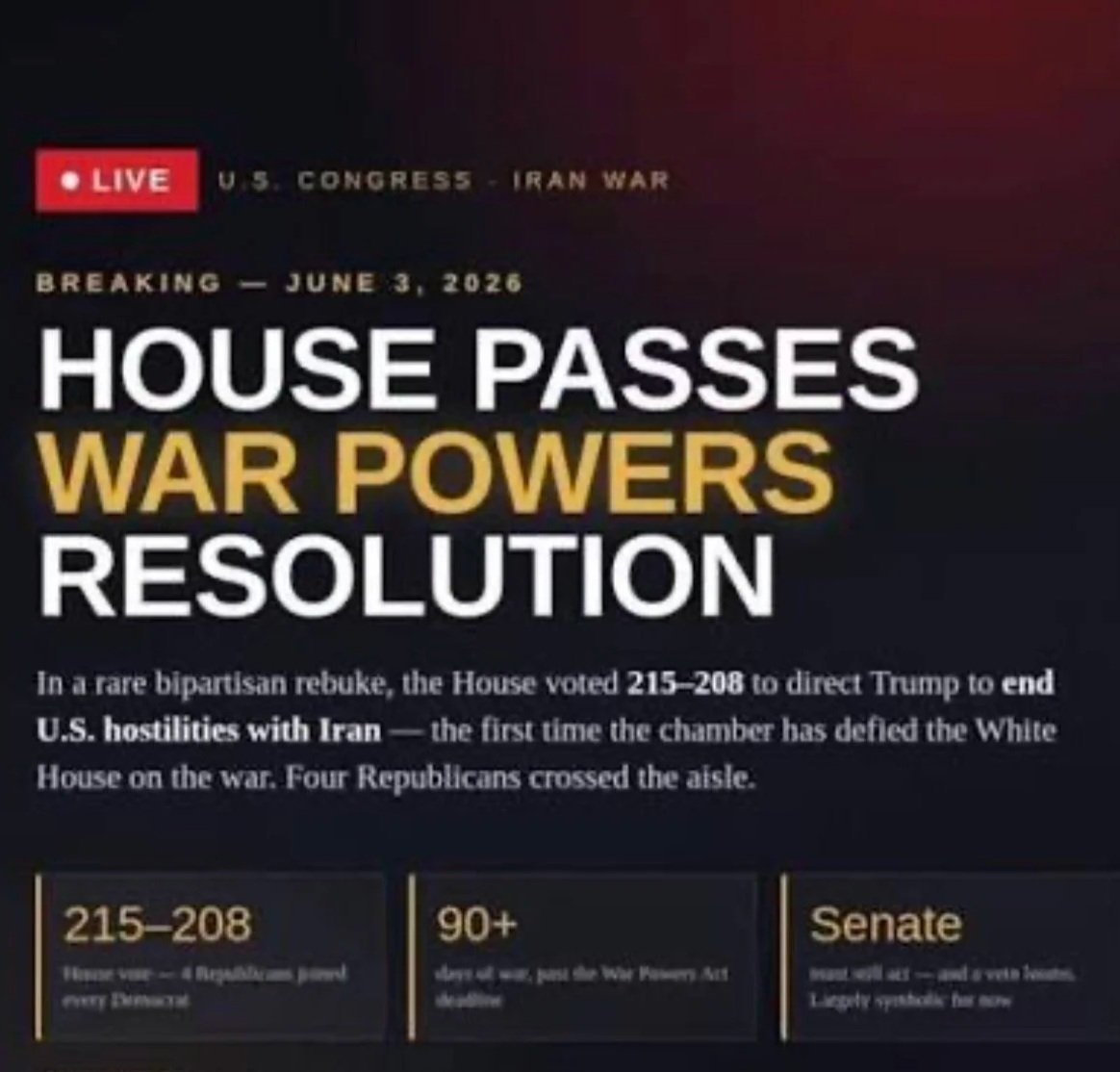
The executive branch, led by Secretary of State Marco Rubio, has fiercely pushed back, arguing that congressional interference signals weakness to Tehran and ties the president's hands during critical negotiations. Because any joint resolution faces an absolute certainty of a presidential veto—and neither chamber currently possesses the two-thirds majority required to override it—the measure functions primarily as a powerful symbol of political fracture at home.
The International Community Sounds the Alarm
The global fallout of a renewed U.S.-Iran conflict has sparked deep anxiety worldwide. United Nations Secretary-General António Guterres addressed an emergency session of the UN Security Council on Wednesday, warning that the international community must not minimize the risk of a "lesser fire becoming a full war" in West Asia.
Economically, the war is inflicting unprecedented pain. Shell CEO Wael Sawan reported Wednesday that the blockade of the Strait of Hormuz has led to global energy disruptions "never seen before," removing over 10% of global oil production from the market. The impacts are proving disproportionately painful in Asia, forcing nations like India, Indonesia, and Vietnam to implement strict fuel rationing.
Geopolitically, the alignment of global powers is hardening. The United States, Great Britain, and their European allies released a joint statement condemning the IRGC for "lethal plotting" and asymmetric threats across Europe and North America. Conversely, Iran’s primary global partners, Russia and China, expressed extreme concern regarding the new round of armed confrontation, jointly calling for immediate Western restraint to prevent a total collapse of regional stability.
